|
||
42. Ropey Schreibersite |
| Listing of Structures |
| Back...Next |
| Meteorite - Oued Bourdim 001, Pallasite of the Eagle Station grouplet. |
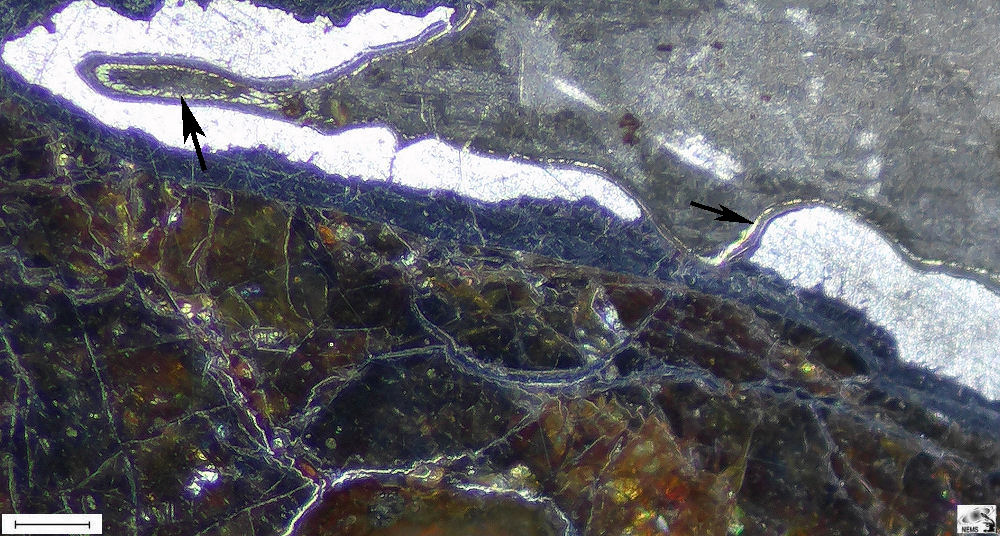
| Figure 1. Scale bar 400 µm. |
| Meteorite: Oued Bourdim 001, Pallasite of the Eagle Station grouplet. |
| Ropey schreibersite (arrowed). |
| Ropey Schreibersite in Iron and
Stony-Iron Meteorites Figure 1. Ropey schreibersite (arrowed) in the Oued Bourdim 001 pallasite (Eagle Station grouplet). Scale bar=400 µm. Schreibersite ((Fe,Ni)3P) is a common accessory phosphide mineral in iron and stony-iron meteorites. Its distinctive “ropey” or vermicular morphology—thin, elongated, twisted, or thread-like crystals—arises from specific nucleation and growth processes during the slow cooling of metallic parent bodies in the early Solar System. Petrogenesis and Microstructural Controls Schreibersite nucleates preferentially at high-energy sites such as kamacite–taenite interfaces, grain boundaries, or Widmanstätten pattern margins within the Fe-Ni metal matrix. These heterogeneous nucleation sites lower the activation energy for precipitation as the metallic melt or solid solution cools below the stability field of the phosphide. The morphology is governed by: • Diffusion-limited growth: Phosphorus, a key component of schreibersite, diffuses through the Fe-Ni alloy to nucleation sites. Nickel also partitions into the growing crystals. Diffusion coefficients for P and Ni in kamacite and taenite are strongly temperature-dependent; slow cooling rates (typically 1–100 °C/Myr in iron meteorite parent bodies) allow controlled, anisotropic growth along preferred crystallographic directions or along interfaces, producing the characteristic ropey or skeletal forms. • Cooling history: In slowly cooled systems, phosphorus exsolves from supersaturated taenite or kamacite, leading to elongated crystals that can weave through the matrix. Faster local cooling or higher phosphorus availability may produce thicker blebs or euhedral crystals, whereas limited P and sluggish diffusion yield the delicate, rope-like textures observed in many specimens. In pallasites such as Oued Bourdim 001 (Eagle Station grouplet), schreibersite occurs within the Fe-Ni metal veins interstitial to olivine crystals. The ropey habit here similarly reflects solid-state exsolution and diffusion during protracted cooling of the core-mantle boundary region of the differentiated parent body. Compositional and Crystallographic Aspects Schreibersite exhibits solid solution between Fe3P and Ni3P end-members, with nickel content typically increasing with decreasing temperature as Ni diffuses preferentially into the phosphide. Trace elements such as cobalt and chromium may also be present. Its tetragonal crystal structure favors anisotropic growth, contributing to the vermicular appearance when constrained by surrounding metal phases. Schreibersite is often associated with other phosphides (e.g., rhabdite, which is morphologically similar but crystallographically distinct) and troilite. In some cases, it records late-stage thermal history, including possible shock or reheating events that can modify its distribution or induce breakdown. Broader Significance Morphology, and composition of schreibersite serve as important petrographic indicators of cooling rates, phosphorus abundance, and thermal metamorphism in iron meteorite parent bodies. Combined with Widmanstätten pattern bandwidths and other exsolution features, it helps constrain metallographic cooling rates and the sizes/depths of asteroidal cores. In pallasites, it provides evidence for mixing of core metal with mantle silicates. These primary-to-secondary structures highlight the complex, multi-stage differentiation and cooling histories of differentiated planetesimals, offering parallels to processes in terrestrial iron-nickel alloys and industrial metallurgy. References • Buchwald, V. F. (1975). Handbook of Iron Meteorites. University of California Press. (Classic reference on schreibersite morphology and occurrence). • Goldstein, J. I., et al. (various works on Fe-Ni-P phase diagrams and diffusion kinetics). • Mittlefehldt, D. W., et al. (2014). Asteroid differentiation and the meteorite record. Treatise on Geochemistry. • Oued Bourdim 001 descriptions in Meteoritical Bulletin and related pallasite studies. • Scott, E. R. D. (1972). Chemical fractionation in iron meteorites and its interpretation. Geochimica et Cosmochimica Acta. • Wasson, J. T. (1985). Meteorites: Their Record of Early Solar-System History. W. H. Freeman. Additional detailed studies on specific meteorites (e.g., Eagle Station pallasites) and experimental phase equilibria in the Fe-Ni-P system are available in Meteoritics & Planetary Science and Geochimica et Cosmochimica Acta. |
| Listing of Structures |